.jpg)

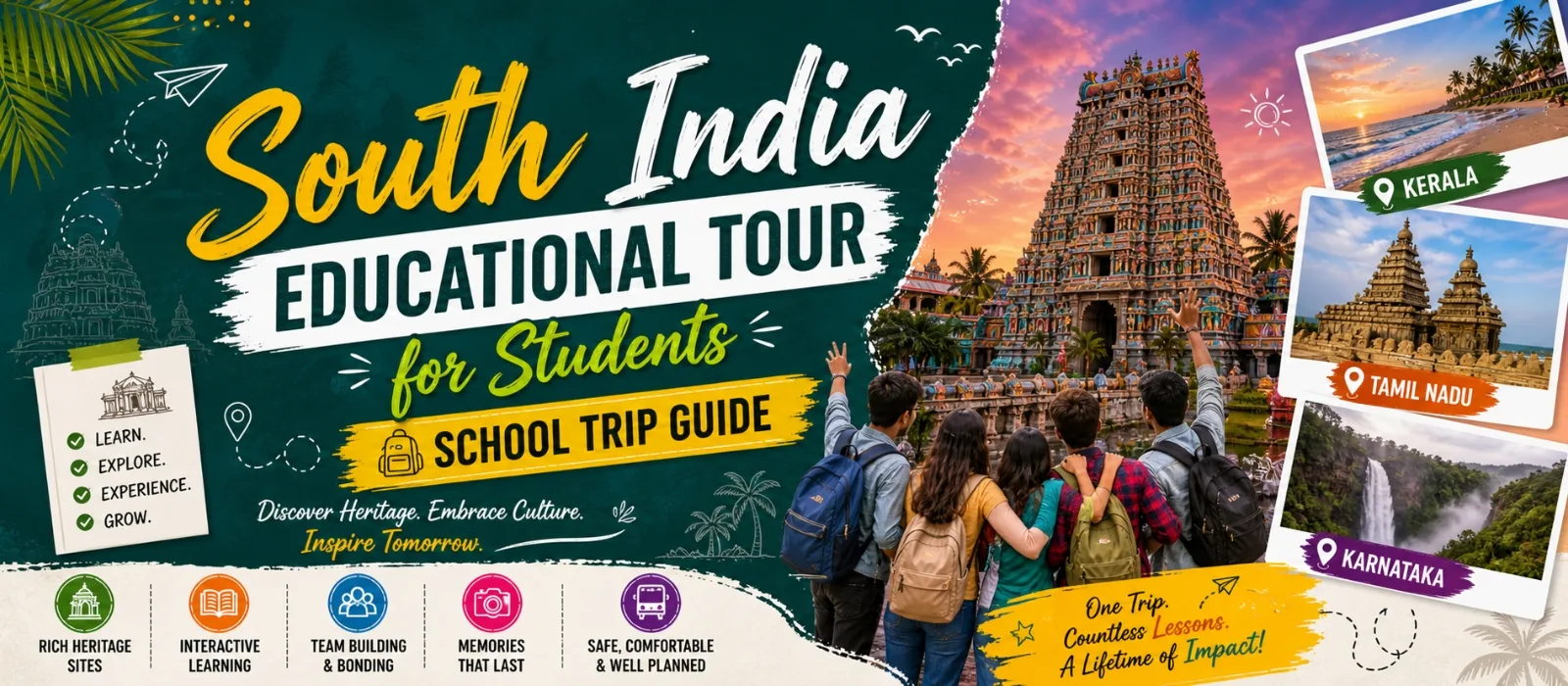
Plan Educational Tours With Confidence
South India is one of the most educationally rich regions in the entire country. The temples, the coastlines, the hill stations, the science institutions, the classical arts and the ancient trade history all come together to create a destination that works extremely well for school and college academic trips.
A South India educational tour for students covers far more ground than typical sightseeing. Students get exposure to Dravidian architecture, marine geography, classical dance and music traditions, biodiversity hotspots, and some of India's most important historical sites. Every subject from history and geography to science and arts finds relevant content somewhere in South India.
This guide is written for school teachers, college coordinators, and educational institutions planning a structured group trip to South India. It covers destination-by-destination learning value, sample itinerary frameworks, package selection guidance, and practical logistics.
Why South India Is Among the Best Educational Tour Destinations in India
South India offers something that very few other regions can match: the combination of living culture and documented history in the same geography.
The temples of Tamil Nadu are not ruins. They are functioning religious and architectural monuments that have been continuously active for over a thousand years. The Western Ghats represent one of the world's eight biodiversity hotspots. Kerala's backwaters are a geography lesson in coastal landforms and traditional livelihoods. Hampi is one of the most significant archaeological sites in Asia. Kanyakumari sits at the confluence of three major water bodies.
| ✓ History students find primary source material everywhere | ✓ Arts students find classical traditions that are still living and practiced |
| ✓ Science students find ecological diversity and geographic variety | ✓ Social science students find temple economies, caste systems, colonial trade routes, and modern governance all visible in the same space |
This is why South India consistently features among the best educational tour destinations in India for school and college groups.
Destination-by-Destination Learning Value
Kerala Educational Tour for Students
Kerala is the right destination for students interested in ecology, geography, social development, and culture. The state consistently ranks at the top in human development indicators, which itself becomes a subject of study for social science students.
What students learn here:
| ✓ The backwaters of Alleppey and Kumarakom teach students about coastal landform geography, including lagoons, estuaries, and the relationship between water bodies and local economies | ✓ Munnar's tea estates are a direct case study in plantation agriculture, colonial economic history, and high-altitude ecology. Students studying economics or history will find the tea estate model a very tangible example of colonial land use patterns |
| ✓ The Periyar Tiger Reserve and the Silent Valley National Park offer firsthand exposure to tropical biodiversity, forest ecosystems, and wildlife conservation | ✓ For arts students, Kerala's classical traditions including Kathakali, Mohiniyattam, and Kalaripayattu are living, performable art forms that connect directly to Indian classical arts curriculum content |
A structured Kerala educational tour for students can cover ecology, geography, history, economics, and arts within a single 5 to 6 day itinerary.
Tamil Nadu Heritage Tour for School Students
Tamil Nadu has one of the deepest historical records of any Indian state. The Dravidian temple architecture found here represents over a thousand years of continuous construction, patronage, and religious practice.
Key sites with academic value:
| ✓ The Brihadeeswarar Temple in Thanjavur is a UNESCO World Heritage Site built in the 11th century by Raja Raja Chola. For students of history and architecture, this temple is a textbook example of Dravidian architectural principles including the vimana tower, the garbhagriha, and the mandapa structure | ✓ The Government Museum in Chennai is one of the oldest museums in India with an exceptional collection of bronze sculptures, archaeological finds, and natural history exhibits. For multi-subject groups this museum alone covers art history, archaeology, and natural sciences |
| ✓ Mahabalipuram, also a UNESCO site, contains rock-cut cave temples, monolithic rathas, and the Shore Temple dating back to the 7th and 8th centuries CE. The site connects directly to curriculum content on early medieval Indian history and Pallava dynasty achievements | ✓ For science students, the Birla Planetarium in Chennai and the Nehru Science Centre offer interactive science learning that complements classroom content |
A Tamil Nadu heritage tour for school students structured around Mahabalipuram, Thanjavur, and Chennai gives students strong academic exposure across history, architecture, art, and science.
Karnataka Temple Tour and Historical Sites
Karnataka is home to two of India's most historically significant archaeological and architectural destinations: Hampi and Mysore. Both are strong candidates for inclusion in any South India school group tour package.
Hampi Historical Tour for Students
Hampi was the capital of the Vijayanagara Empire, one of the largest and most powerful empires in medieval Indian history. The site was declared a UNESCO World Heritage Site and contains over 1,600 monuments spread across a dramatic boulder-strewn landscape.
For students, a Hampi historical tour for students provides direct evidence of medieval urban planning, temple architecture, water management systems, trade infrastructure, and military fortification. The Vitthala Temple with its famous stone chariot, the Hazara Rama Temple with its wall carvings depicting the Ramayana, and the Royal Enclosure with its stepped tank all tell specific stories about how the empire functioned.
History students will find Hampi invaluable for understanding Deccan history, medieval trade routes, and the eventual fall of Vijayanagara to the Deccan Sultanates in 1565 CE.
Mysore Educational Trip for School Students
Mysore is often called the city of palaces and it earns that title. The Mysore Palace, one of the most visited monuments in India, is a spectacular example of Indo-Saracenic architecture built in the early 20th century under the Wadiyar dynasty.
A Mysore educational trip for school students goes beyond the palace. The city has a strong science and technology legacy. The Central Food Technological Research Institute (CFTRI) located in Mysore is one of India's premier food science institutions and accepts academic visits from student groups. Mysore University, established in 1916, is one of the oldest universities in South India and is architecturally and historically significant.
The Jaganmohan Palace Art Gallery contains an important collection of paintings, musical instruments, and royal artifacts that art and history students will find highly relevant.
Ooty Educational Trip for School Students
Ooty, officially called Udhagamandalam, is located in the Nilgiri Hills of Tamil Nadu at an altitude of around 2,240 meters. It is one of the most ecologically significant hill stations in South India.
An Ooty educational trip for school students works particularly well for science, geography, and environmental studies groups.
| ✓ The Nilgiri Biosphere Reserve surrounding Ooty is a UNESCO-designated biosphere and one of the most biodiverse regions in India. Students can observe shola forests, grasslands, and the unique high-altitude ecosystem of the Nilgiris | ✓ The Nilgiri Mountain Railway, a UNESCO World Heritage Site, runs between Mettupalayam and Ooty and offers students the same type of heritage railway learning experience as the Kalka-Shimla railway in the north |
| ✓ The Botanical Garden in Ooty, established in 1848, houses over 650 plant species including a 20 million year old fossilized tree trunk — a structured, well-documented learning resource for botany and environmental science students | ✓ The presence of three distinct tribal communities — the Todas, the Kotas, and the Irulas — makes this region interesting for anthropology and social science students |
Kanyakumari Educational Tour for Students
Kanyakumari sits at the southernmost tip of the Indian mainland where the Arabian Sea, the Bay of Bengal, and the Indian Ocean meet. This geographical fact alone makes it significant for geography students.
| ✓ For geography students, the confluence of three water bodies, the visible difference in water colors due to varying salinity and current patterns, and the coastal landform studies are all directly applicable to curriculum content | ✓ Kanyakumari's sunrise and sunset viewed simultaneously from the same point is geographically possible here due to the narrow land tip orientation — a teachable moment for astronomy and geography students |
| ✓ The Vivekananda Rock Memorial, built on a rock island 500 meters from the mainland, is historically and philosophically significant — connecting to Indian philosophy and Swami Vivekananda's life and work | ✓ The Thiruvalluvar Statue nearby connects to Tamil literature and classical philosophy curriculum |
Andhra Pradesh Educational Group Tour
Andhra Pradesh offers a set of academic destinations that are underutilized by school groups from North India but extremely valuable for curriculum alignment.
| ✓ Tirupati is home to the Sri Venkateswara Temple, one of the wealthiest and most visited religious institutions in the world. For students of religious studies, economics of pilgrimage, and Dravidian architecture, Tirupati offers a very different kind of case study | ✓ The ISRO Sriharikota launch facility, located in the Nellore district, conducts guided academic visits for student groups. For science and engineering students, a visit to an active space launch facility has an educational impact that no classroom session can replicate |
| ✓ Amaravati, the ancient Buddhist site on the banks of the Krishna River, contains the remains of one of the largest and oldest Buddhist stupas in India dating to the 3rd century BCE. For history students studying Buddhist India, Amaravati is as significant as Sanchi |
For an Andhra Pradesh educational group tour, the combination of Tirupati, Amaravati, and Sriharikota gives students exposure to religious history, ancient archaeology, and modern space science in a single extended itinerary.
South India Cultural Tour for School Groups: What to Include
A South India cultural tour school group itinerary should not just list monuments. It should connect cultural experiences to academic content. Here is a framework for building cultural learning into the trip:
| Cultural Experience | Academic Connection | Recommended Location |
|---|---|---|
| Bharatanatyam performance | Classical Indian dance curriculum | Chennai, Thanjavur |
| Kathakali performance | Kerala performing arts, classical traditions | Kochi, Thiruvananthapuram |
| Temple sculpture observation | Art history, Dravidian architecture | Mahabalipuram, Hampi, Thanjavur |
| Tribal community interaction | Anthropology, social studies | Nilgiris, Wayanad |
| Classical Carnatic music session | Indian classical music curriculum | Mysore, Chennai |
| Kalaripayattu demonstration | Martial arts history, Kerala culture | Kozhikode, Thrissur |
Each of these experiences connects to a specific curriculum area and can be reinforced with pre-trip reading and post-trip reflection activities.
Sample Itinerary for a South India School Group Tour Package
A complete South India school group tour package covering multiple states works best over 7 to 10 days. Here is an 8-day sample framework for groups starting from North India:
| Day | Location | Educational Focus |
|---|---|---|
| Day 1 | Travel and arrival in Chennai | Orientation, local area walk |
| Day 2 | Chennai | Government Museum, Birla Planetarium, Marina Beach geography session |
| Day 3 | Mahabalipuram and Kanchipuram | Pallava architecture, Shore Temple, silk weaving industry |
| Day 4 | Thanjavur | Brihadeeswarar Temple, Chola history, Saraswathi Mahal Library |
| Day 5 | Ooty | Nilgiri Biosphere Reserve, Botanical Garden, Nilgiri Railway |
| Day 6 | Mysore | Mysore Palace, CFTRI visit, Jaganmohan Art Gallery |
| Day 7 | Hampi | Vijayanagara Empire archaeological site, Vitthala Temple, Royal Enclosure |
| Day 8 | Return journey | Reflection session, departure |
This itinerary covers history, architecture, science, ecology, art, and geography across five distinct locations. Teachers can assign daily journal writing or observation worksheets to reinforce learning at each stop.
How to Choose the Right South India Educational Tour Package
Selecting a good South India college educational trip or school package requires looking beyond the price. Here is what a well-structured package should include:
Complete package inclusions:
| ✓ AC coach or train travel between cities and states | ✓ A trained educational guide at each major site |
| ✓ Accommodation in group-friendly hotels or lodges | ✓ Emergency medical support and comprehensive travel insurance |
| ✓ All three meals with options suited to student groups | ✓ All inter-city and intra-city local transfers |
| ✓ Entry fees for all monuments and museums in the itinerary |
Per student cost range: For a 7 to 8 day South India school trip from North India, costs typically range between Rs 12,000 and Rs 22,000 per student depending on group size, transport mode, hotel category, and whether flights or trains are used for the long-distance portion. Larger groups of 60 students or more generally get significantly better per-head rates. Groups of 100 or more can negotiate custom pricing with tour operators.
Signs of a quality educational tour operator:
| ✓ Itinerary mentions specific educational objectives at each site | ✓ Insurance and safety protocols are documented |
| ✓ Guide credentials are shared in advance | ✓ The operator has experience with academic institutions specifically |
Safety and Logistics for a South India Group Trip
South India is a well-developed tourist region with good infrastructure but long-distance group travel requires advance planning.
Documentation Needed
Parental consent forms, student identity cards, school authorization letters, and medical forms for students with health conditions. Colleges need institutional permission letters.
Staff-to-Student Ratio
A minimum ratio of 1 teacher or supervisor for every 10 students is recommended. For college groups, 1 per 15 is generally acceptable.
Health Considerations
| ✓ South India has a warm and humid climate for most of the year. Students coming from dry northern regions need time to adjust. Hydration is important throughout the trip | ✓ Areas like Ooty and the Western Ghats are cooler so students should pack accordingly |
Best Travel Season
| ✓ October to March is the ideal window for a South India educational trip — cooler and drier across Tamil Nadu, Karnataka, and Andhra Pradesh | ✓ July to September is monsoon season which affects some road routes and heritage sites |
| ✓ April to June can be very hot in Tamil Nadu and Andhra Pradesh though Kerala and hill stations remain manageable |
Why EduTour Plans South India Educational Trips That Actually Work
EduTour has been designing educational group tours for Indian schools and colleges since 2010. With over 1,000 institutional partners and more than 5,000 successfully completed tours, the company has specific experience with South India routes.
| ✓ Their South India packages are built with academic alignment as the starting point. Every itinerary is designed to connect to real curriculum content | ✓ Safety logistics, insurance, and group management are handled end to end |
| ✓ Guides are briefed on subject relevance so they explain context rather than just describe monuments | ✓ EduTour builds customized plans based on the institution's academic calendar and subject requirements |
Final Thought
A South India educational tour for students offers one of the most academically diverse travel experiences available anywhere in India. From UNESCO World Heritage Sites and ancient temple complexes to living ecosystems, space launch facilities, and classical performing arts, South India gives students direct contact with content they study in classrooms every day.
The quality of the trip depends on how well the itinerary is planned, how knowledgeable the guides are, and whether the tour operator understands the difference between a tourist trip and an academic one.
Schools and colleges that invest in well-structured South India educational trips give their students a learning experience that stays with them well beyond the academic year.
FAQ's
Q1. What is the best time to plan a South India educational tour for students?
October to March is the most suitable window. The weather is cooler and drier across Tamil Nadu, Karnataka, and Andhra Pradesh. Kerala and Ooty are pleasant year-round though monsoon months bring heavy rainfall that can disrupt outdoor visits and road travel.
Q2. How many days are needed for a proper South India school group tour?
A minimum of 7 to 8 days is recommended to cover at least 3 to 4 major educational destinations meaningfully. Rushed 4 or 5 day itineraries often skip important sites or spend too little time at each location for real academic engagement.
Q3. Which South India destinations are best for science students?
Ooty for ecology and botany, Sriharikota in Andhra Pradesh for space science, Kanyakumari for geography, and the Periyar Tiger Reserve in Kerala for wildlife and conservation are the strongest options for science-focused student groups.
Q4. Is Hampi suitable for all age groups of students?
Hampi works well for students from Class 8 upwards. The site requires considerable walking across uneven terrain. Younger students may find it physically demanding. For senior school and college groups, Hampi is one of the most academically valuable historical sites in South India.
Q5. Can a South India college educational trip be customized by academic stream?
Yes. Engineering and science students can focus on ISRO Sriharikota, Nilgiri ecology, and heritage railway engineering. Management students can study temple economies and plantation agriculture models. Arts and humanities students have the richest options across classical performance, Dravidian architecture, and museum collections.
Q6. What documents does a school need before booking a South India group tour?
Schools need parental consent forms for all students, institutional approval from the principal, student identity records, medical information forms, and a confirmed staff supervision plan. Tour operators like EduTour provide documentation checklists as part of the booking process.
Q7. How large can a student group be for a South India educational tour?
Groups can range from 30 to 300 students. Larger groups are managed by splitting into academic batches at major sites so that every student has proper access to guides and learning content. Bus and accommodation logistics are handled proportionally based on group size.
