.jpg)

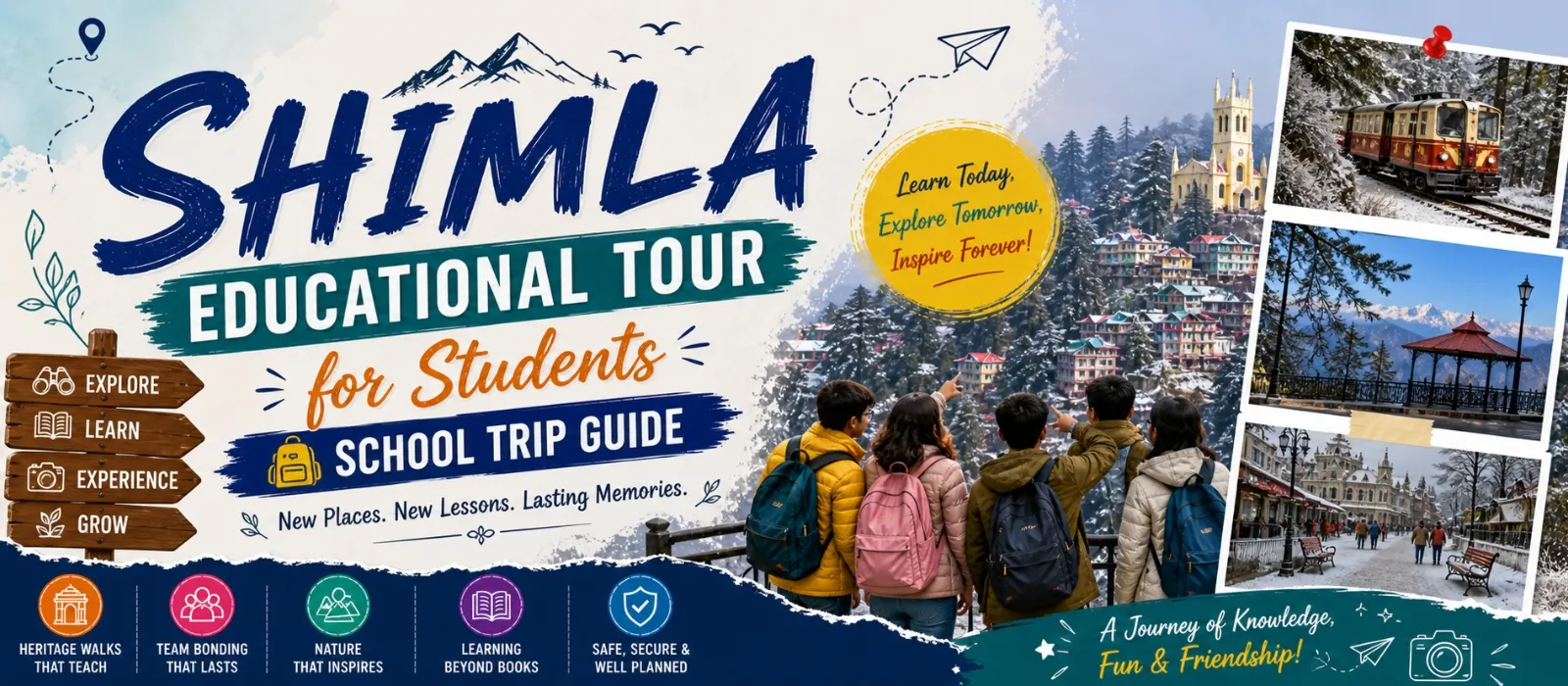
Plan Educational Tours With Confidence
Every school trip has a purpose. Some trips are just recreational. But a well-planned Shimla educational tour for students is something different altogether. It connects what students read in textbooks with what actually exists in the real world.
Shimla is one of those rare destinations where history, science, culture, and nature all come together in one place. The city was India's summer capital during British rule. It has a UNESCO World Heritage railway line. It has museums, research institutions, alpine ecosystems, and living examples of colonial architecture. For students from Class 6 to college level, this city has genuine academic value.
This guide covers everything a school or college coordinator needs to know before planning a Shimla student group tour, from the best sites to visit, to how to pick the right package, to safety planning and cost expectations.
Why Shimla Works So Well as a School Trip Destination in North India
There are many hill stations in India. But Shimla has a combination that few other destinations offer for academic purposes.
| ✓ History: Shimla served as the summer capital of British India from 1864 onwards. Key decisions about modern India — including the Simla Conference of 1945 related to Indian independence — happened here. The buildings, the institutions, and the streets all carry that history visibly | ✓ Culture: Himachali traditions, folk arts, local food, and the unique blend of colonial and indigenous architecture give students exposure to a way of life very different from urban plains India |
| ✓ Science: Shimla sits within the outer Himalayan and Shivalik ranges. The geography, climate zones, and biodiversity of this region make it a direct, real-world resource for students studying environmental science, biology, and geography |
This is why Shimla consistently comes up as one of the best school trip destinations in North India for groups from Rajasthan, Delhi, Punjab, Haryana, and Uttar Pradesh.
Top Educational Sites to Visit in Shimla
A Shimla school trip package should be built around sites that have real learning value, not just good views. Here is a location-by-location breakdown of what students gain from each stop.
Viceregal Lodge (Rashtrapati Niwas)
Built in 1888, the Viceregal Lodge was the official residence of the British Viceroy of India. This Tudor-style structure hosted some of the most significant political meetings in Indian history, including the Simla Conference of 1945 where discussions on India's partition took place.
Students of history, civics, and political science will find the guided tour here extremely informative. The interiors, the archives, and the institutional context give students a physical connection to the events they study in textbooks.
Kalka-Shimla Heritage Railway
This is a UNESCO World Heritage Site and one of the most impressive engineering achievements of the colonial period. Built between 1898 and 1903, this narrow gauge railway runs through 102 tunnels and over 800 bridges across steep mountain terrain.
For students of engineering, physics, or history, experiencing this railway firsthand raises questions about construction methods, material science, and colonial infrastructure investment. A dedicated session explaining how the railway was built adds strong academic value to the experience.
Himachal Pradesh State Museum
The State Museum in Shimla houses miniature Pahari paintings, metal sculptures, archaeological finds, coins, and folk art objects from across Himachal Pradesh. It is a valuable resource for students studying art history, culture, and archaeology.
Teachers can use this visit as a follow-up to classroom lessons on Pahari art traditions, making the connection between academic study and physical objects very direct.
Indian Institute of Advanced Study (IIAS)
Located within the Viceregal Lodge complex, the IIAS is one of India's premier academic research institutions. College groups, especially from humanities, social sciences, and literature streams, can benefit from a visit here. The library contains rare manuscripts and archival material that students interested in research will find genuinely interesting.
Kufri and Green Valley
For students studying environmental science, ecology, or geography, Kufri and the surrounding Green Valley area offer hands-on exposure to temperate forest ecosystems, high-altitude agriculture, and Himalayan flora. Schools can structure a small field study exercise here involving observation, data recording, and plant identification.
Chail and Rocky Valley
Chail is famous for having the world's highest cricket ground and is surrounded by dense cedar and rhododendron forests. The drive through Rocky Valley and Chail's forest zones gives students direct exposure to Himachal Pradesh's biodiversity and forest conservation efforts.
What a Good Shimla Student Group Tour Itinerary Looks Like
A structured Shimla student group tour should have one clear educational theme per day. This keeps students focused and prevents the trip from becoming a rushed sightseeing exercise.
Here is a sample 5-day framework that works well for both school and college groups:
| Day | Theme | Key Activities |
|---|---|---|
| Day 1 | Arrival and Orientation | Travel to Shimla, check-in, Mall Road orientation walk |
| Day 2 | History and Architecture | Viceregal Lodge, Christ Church, State Museum, heritage walk |
| Day 3 | Science and Ecology | Kufri, Green Valley, nature trail, ecology field session |
| Day 4 | Engineering and Transport | Kalka-Shimla Railway experience, Jakhu Hill, interactive discussion |
| Day 5 | Culture and Departure | Local market visit, cultural interaction, return journey |
Teachers can assign pre-trip reading aligned with each day's theme and post-trip activities such as reports, presentations, or journal entries to reinforce what students observed.
Shimla College Tour Package: What Higher Education Groups Should Include
A Shimla college tour package has different priorities compared to a school trip. College students benefit more from interaction-based sessions and stream-specific content rather than general sightseeing.
For Engineering Students
The Kalka-Shimla Heritage Railway should be the anchor of any engineering-focused itinerary. Understanding how narrow gauge railway lines were laid through mountain terrain with pre-modern tools is a genuinely instructive exercise. Sessions on tunnel engineering, bridge load calculations, and track gradient management can be built around this visit.
For Management and Business Students
Shimla's apple orchard economy, its mountain tourism industry, and the local handicraft market all offer real case studies in regional economics and small business management. A structured interaction with local entrepreneurs or tourism operators adds meaningful practical learning.
For Science and Environment Students
Field study sessions in Kufri, nature trails in Green Valley, and visits to Chail Wildlife Sanctuary work well for science students. Data collection activities, species observation, and climate zone mapping can all be built into the academic program.
For Social Science and Humanities Students
Shimla offers three distinct study threads: colonial history, Indian independence narrative, and Himachali folk culture. The Viceregal Lodge, the State Museum, and interactions with local artisans each connect to a different aspect of the social sciences curriculum.
Shimla Manali Student Tour Package: Why Many Schools Combine Both Destinations
A Shimla Manali student tour package is one of the most popular extended options for schools and colleges coming from North India. The combination makes strong academic sense because the two destinations offer completely different learning environments.
| ✓ Shimla provides history, colonial architecture, and temperate ecology | ✓ The route between Shimla and Manali passes through the Kullu Valley, apple orchards, the Beas River, and multiple Himachali villages — itself a field study in agricultural economics, river geography, and mountain land use |
| ✓ Manali adds high-altitude geography, glacial terrain, Buddhist and Hindu religious sites, and adventure-based experiential learning | ✓ Rohtang Pass, when accessible, gives students exposure to glacial deposits, periglacial landforms, and high-altitude climate conditions that directly connect to geography curriculum content |
For a Shimla Manali combination, a minimum of 7 nights and 8 days is recommended to avoid rushed visits and allow adequate time at each educational site.
How to Evaluate an Affordable Student Tour Package for Shimla
Cost is always a factor for schools and colleges. The goal is not to find the cheapest package but to find the best value for the educational investment. Here is what a complete affordable student tour package Shimla should include:
Inclusions to look for:
| ✓ AC Volvo coach or tempo traveller transport from the origin city | ✓ A dedicated educational guide or coordinator with subject knowledge |
| ✓ Group accommodation in hotels or guest houses with proper facilities | ✓ Emergency medical support and travel insurance for all participants |
| ✓ All three meals daily | ✓ All local transfers between sites |
| ✓ Entry tickets for all sites in the itinerary |
Things that indicate a low-quality package:
| ✓ Itinerary with no educational content, only sightseeing stops | ✓ No travel insurance mentioned |
| ✓ No dedicated academic guide, only a generic tour operator | ✓ Vague descriptions of accommodation or meals |
For a 5-day Shimla school trip from Rajasthan, per student costs typically range between Rs 6,000 and Rs 12,000. This varies depending on group size, transport mode, hotel category, and the number of educational visits included. Groups of 50 or more generally get better per-head rates.
Safety and Logistics Planning for a Hill Station Educational Tour
Any hill station educational tour Himachal Pradesh requires advance planning for logistics and safety. Mountain terrain has specific considerations that a plains trip does not.
Documentation Required
Schools should collect signed parental consent forms, carry student identity cards, and maintain a staff-to-student ratio of at least 1 to 10. College groups need institutional permission letters and student IDs.
Health Preparations
| ✓ Mild altitude sickness can affect students coming from lower altitude regions. Schools should carry a basic first aid kit and know the address of the nearest hospital | ✓ Brief students on the importance of hydration and warm clothing. Students with pre-existing respiratory conditions should consult a doctor before the trip |
Best Travel Season
| ✓ March to June and September to November are the ideal months for a Shimla educational trip | ✓ July and August should be avoided due to heavy rainfall and landslide risk on mountain roads |
| ✓ December to February brings snow which can disrupt access to some sites |
Clothing and Equipment
Even during summer months, Shimla evenings can be cold. Students should pack light woolens or a jacket regardless of the travel month. Proper walking shoes with grip are important for heritage walks, nature trails, and hilly terrain.
Why Schools Trust EduTour for Shimla Educational Group Tours
Planning a complete Shimla educational trip for school students involves transport, accommodation, site bookings, guide coordination, insurance, and academic itinerary design. Most schools do not have the internal resources to manage all of this independently.
EduTour has been organizing educational group tours for schools and colleges across India since 2010. With over 1,000 institutional partners and more than 5,000 successfully executed tours, the company understands what academic institutions need from a student trip.
| ✓ Their Shimla packages are built with curriculum alignment in mind. Guides are briefed on subject relevance at each site | ✓ Safety and logistics are handled end to end so teachers can focus on the educational experience rather than trip management |
| ✓ Itineraries are designed by age group and academic stream |
Final Thought
A Shimla educational tour for students gives schools and colleges one of the most academically rich destinations available in North India. The combination of documented colonial history, Himalayan ecology, Himachali culture, and engineering heritage means that students from almost every academic stream will find something directly connected to their coursework.
The difference between a good school trip and a great one comes down to planning. A structured itinerary, a knowledgeable guide, and an operator who understands academic goals rather than just travel logistics make all the difference in what students take back from the experience.
For schools and colleges planning a Shimla trip and looking for a customized package built around specific learning objectives, EduTour has the experience and institutional knowledge to make it work.
FAQ's
Q1. What is the best time to plan a Shimla educational tour for students?
March to June is the most suitable period because weather is pleasant and all sites are fully accessible. September and October are equally good. July and August should be avoided due to monsoon rains and mountain road risks.
Q2. How many days are needed for a proper Shimla school trip?
A 4-night, 5-day trip is the recommended minimum for a Shimla student group tour. This provides enough time to cover 5 to 6 key educational sites without exhausting students or rushing through content.
Q3. Is Shimla safe for student group travel?
Yes. Shimla has good road infrastructure, hospital facilities, and police coverage. It is one of the well-managed tourist destinations in Himachal Pradesh. A reliable tour operator with proper safety protocols adds additional security for student groups.
Q4. Which subjects benefit most from a Shimla heritage tour for students?
History, Geography, Environmental Science, Political Science, Art and Culture, and Architecture all connect directly to Shimla's sites. College students in Engineering, Management, and Social Sciences also find strong academic value here depending on their itinerary.
Q5. Can a Shimla college tour package be customized by academic stream?
Yes. Engineering groups can focus on the heritage railway and infrastructure. Science groups can plan ecology field sessions in Kufri. Management students can visit local enterprises and tourism businesses. A good operator will customize the itinerary based on the institution's academic requirements.
Q6. What does an affordable Shimla student tour package typically include?
A complete package should cover road transport, accommodation, all meals, site entry tickets, a trained educational guide, travel insurance, and local transfers. Any package that excludes insurance or meals should be reviewed carefully before booking.
Q7. How many students can travel together on a Shimla group tour?
Group tours can be organized for groups starting from 30 students. Larger groups of 100 to 300 students are managed by splitting into batches for site visits so that the quality of learning and safety at each location is maintained properly.
