.jpg)

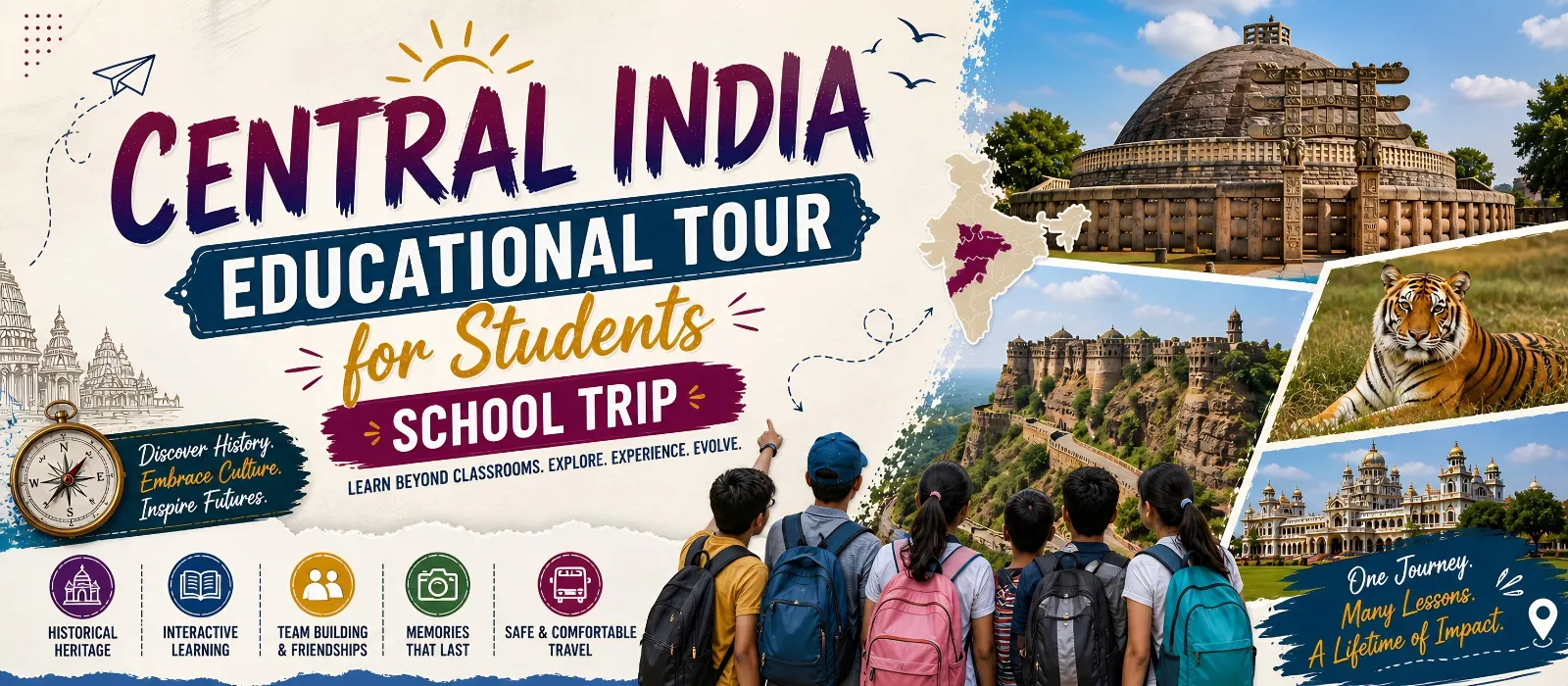
Madhya Pradesh sits right in the geographical heart of India and its academic value for student groups is genuinely underestimated. Most schools default to Rajasthan or South India for heritage trips but a Central India educational tour for students through Madhya Pradesh offers content that simply cannot be found anywhere else in the country.
Buddhist stupas from the 3rd century BCE. Temples carved a thousand years ago with no modern tools. Tiger reserves that are among the best managed in Asia. Tribal communities with living cultural traditions. UNESCO World Heritage Sites that span different civilizations and centuries. All of this is within one state.
This guide is written for school teachers, college trip coordinators, and academic institutions that want to plan a meaningful, curriculum-connected group tour to Central India. Every section covers a specific destination with clear educational value, followed by itinerary frameworks, package guidance, and practical logistics.
Why Madhya Pradesh Is One of the Best Educational Tour Destinations in Central India
Madhya Pradesh has more UNESCO World Heritage Sites than most Indian states. It has the highest number of tiger reserves in the country. It has archaeological sites that cover Buddhist, Hindu, and tribal history across different centuries. And it has a geography that includes river valleys, plateaus, dense forests, and agricultural plains all within driveable distance of each other.
For students, this density of educational content within a single state is what makes a Madhya Pradesh educational tour for students so productive. A single well-planned trip can cover archaeology, ecology, architecture, religious history, tribal anthropology, and environmental science without crossing state boundaries.
| ✓ Road and rail connectivity is good between major destinations | ✓ The student-friendly nature of most heritage sites means group visits are manageable and safe |
| ✓ Accommodation options for student groups exist across price ranges |
Destination-by-Destination Learning Value
Sanchi Stupa Educational Trip for School Students
Sanchi is possibly the most important Buddhist site in India for academic purposes. Located about 46 km from Bhopal, the Sanchi complex contains the Great Stupa commissioned by Emperor Ashoka in the 3rd century BCE along with smaller stupas, pillars, and monasteries built over several centuries.
A Sanchi Stupa educational trip for school students connects directly to curriculum content on Mauryan history, Emperor Ashoka, the spread of Buddhism, and ancient Indian architecture. The four elaborately carved toranas or gateways at the Great Stupa depict scenes from the Buddha's previous lives, Ashoka's pilgrimage, and early Buddhist community life. These carvings are primary historical documents in stone.
The Ashoka Pillar at Sanchi, though broken, is an original Mauryan artifact. Standing next to it gives students a physical sense of history that no textbook photograph can replicate. The Archaeological Museum at Sanchi houses original sculptures, pottery, and relics excavated from the site.
| ✓ Subject connections: History (Mauryan period, Ashoka, Buddhism), Art History (stupa architecture, torana carvings), Religious Studies, Archaeology |
Khajuraho Educational Tour for Students
Khajuraho is a UNESCO World Heritage Site in Chhatarpur district of Madhya Pradesh. The temple complex was built between 950 CE and 1050 CE by the Chandela dynasty and represents one of the finest examples of medieval Indian temple architecture.
A Khajuraho educational tour for students is often misunderstood because the temples are associated primarily with their erotic sculptures. In academic terms these sculptures represent only about 10 percent of the total carvings. The majority of the temple art depicts celestial beings, deities, warriors, musicians, animals, and scenes from daily medieval life.
For students, Khajuraho is a rich primary source for understanding medieval Indian society, temple architectural canons, the Nagara style of North Indian temple construction, and Chandela dynasty history. The temples are divided into three groups: western, eastern, and southern. The western group contains the Kandariya Mahadeva Temple which is considered the architectural high point of the entire complex.
The Archaeological Museum at Khajuraho displays sculptures removed from damaged temple sections and gives students a closer look at the craftsmanship and iconographic programs of medieval temple building.
| ✓ Subject connections: History (medieval India, Chandela dynasty), Architecture, Art History (Nagara style), Archaeology, Social History |
Bhopal Educational Tour for School Students
Bhopal, the state capital of Madhya Pradesh, is itself a strong educational destination with multiple academic resources concentrated in one city.
| ✓ The Bharat Bhavan is a multi-arts cultural complex functioning as a museum, performance space, and archive for Indian tribal and folk arts. For students of Indian culture, visual arts, and performing arts it is one of the most comprehensive resources in Central India | ✓ The Birla Museum in Bhopal has an excellent collection of sculptures spanning from the 1st century CE to the 12th century CE, giving students a visual timeline of sculptural development in Central India |
| ✓ The State Museum of Madhya Pradesh houses collections covering prehistoric rock art, Mauryan and Gupta period artifacts, medieval sculpture, and tribal material culture — spanning multiple centuries and subject areas | ✓ The Regional Science Centre in Bhopal offers interactive exhibits on physics, biology, and earth sciences with specific content on Central India's ecology |
A Bhopal educational tour for school students is especially useful as a base camp. Bhopal is within 1 to 3 hours of Sanchi, Bhimbetka, and several wildlife sanctuaries making it an efficient hub for multi-destination Central India trips.
| ✓ Subject connections: History, Art, Tribal Culture, Science, Environmental Studies, Archaeology |
Bhimbetka Rock Shelters: Prehistoric India in Stone
Located about 45 km from Bhopal, the Bhimbetka rock shelters are another UNESCO World Heritage Site. These shelters contain rock paintings dating from the Upper Palaeolithic period, approximately 30,000 years ago, through to the early historical period.
For students studying prehistoric India, human evolution, and the origins of art, Bhimbetka provides direct contact with evidence that is genuinely ancient. The paintings depict hunting scenes, animals, community rituals, and early agricultural activities. They are among the oldest evidence of human habitation in the Indian subcontinent.
A combined Bhopal and Bhimbetka itinerary gives students a historical sweep from 30,000 years ago at Bhimbetka to the Mauryan period at Sanchi to the medieval period at Bhopal's museums, all within a two to three day cluster.
| ✓ Subject connections: Prehistoric History, Anthropology, Archaeology, Art History, Social Evolution Studies |
Kanha and Bandhavgarh Educational Tour for Students
Madhya Pradesh has the highest number of tiger reserves in India. Kanha and Bandhavgarh are the two most academically significant for student groups planning a Central India wildlife tour for school students.
Kanha Tiger Reserve
Kanha is one of the largest national parks in Central India and served as the inspiration for Rudyard Kipling's The Jungle Book. For students it offers more than wildlife spotting. Kanha is a functioning conservation ecosystem where students can observe predator-prey relationships, forest zone transitions, grassland ecology, and river system habitats within a single safari.
The Kanha interpretation centre provides structured educational content on tiger conservation, habitat management, and human-wildlife conflict which connects directly to environmental science and conservation studies curriculum content.
Bandhavgarh Tiger Reserve
Bandhavgarh is known for having one of the highest tiger densities among Indian reserves. Beyond wildlife, the reserve also contains the Bandhavgarh Fort and a series of cave temples with Buddhist inscriptions. For students interested in both ecology and history, Bandhavgarh offers an unusual combination.
A Kanha Bandhavgarh educational tour for students requires a minimum of 3 to 4 days across both reserves to get educational value beyond a single safari experience. Schools should plan structured field observation exercises including species recording, habitat classification, and ecosystem mapping as part of the academic program.
| ✓ Subject connections: Environmental Science, Ecology, Wildlife Conservation, Geography, Biology, History (Bandhavgarh fort) |
Ujjain and Omkareshwar Educational Trip for Students
An Ujjain Omkareshwar educational trip for students is relevant for students studying Indian religious history, river geography, and ancient urban planning.
| ✓ Ujjain is one of the seven sacred cities of Hinduism and has been a centre of learning, astronomy, and commerce since ancient times. The Vedha Shala (Jantar Mantar of Ujjain) is an 18th century observatory with instruments designed to measure solar and stellar positions | ✓ Omkareshwar is located about 77 km from Indore at the confluence of the Narmada and Kaveri rivers. The island formed here by the forking Narmada is shaped like the Sanskrit symbol Om — a geographically and culturally significant site for geography students |
| ✓ The Mahakaleshwar Temple is one of the twelve Jyotirlingas and has been a place of active worship for over a thousand years. For religious studies and history students this temple represents living continuity between ancient religious traditions and present practice | ✓ The Adi Shankaracharya connection to Omkareshwar is important for students studying Indian philosophy. Shankaracharya is believed to have studied under his guru Govinda Bhagavatpada here before revitalizing Advaita Vedanta philosophy |
| ✓ Subject connections: Religious History, Philosophy, Ancient Astronomy, Geography, River Studies, Cultural Studies |
Central India Tribal Culture Tour for Students
Madhya Pradesh has one of the largest tribal populations in India with over 40 recognized tribal communities including the Gond, Baiga, Bhil, Korku, and Sahariya. A Central India tribal culture tour for students focused on tribal art, language, and livelihood gives students academic exposure to a dimension of Indian society that most urban curricula never adequately cover.
| ✓ The Gond art tradition, which has gained international recognition in recent decades, originates from Madhya Pradesh. Visiting Gond art communities in the Mandla or Dindori districts gives students direct exposure to this tradition — art and design students find the visual vocabulary and symbolic language academically rich | ✓ The Tribal Museum in Bhopal, run by the Tribal Research and Development Institute of Madhya Pradesh, is one of the finest tribal museums in India. It documents material culture, agricultural practices, musical instruments, ornaments, and ritual objects of major tribal communities with excellent interpretive content |
| ✓ Subject connections: Anthropology, Social Science, Art and Design, Environmental Studies, Cultural Studies, Sociology |
Madhya Pradesh Heritage Tour for College Students: Gwalior and Orchha
A Madhya Pradesh heritage tour for college students would be incomplete without Gwalior and Orchha.
Gwalior Fort
The Gwalior Fort is one of the most impressive fortifications in India. Built on a sandstone hill rising 100 meters above the surrounding plain, the fort complex contains palaces, temples, and water tanks built across different dynasties from the 6th century CE onwards.
The Man Singh Palace inside the fort is a 15th century structure with distinctive blue ceramic tile work that represents a unique fusion of Central Indian and Central Asian architectural influences. For architecture and history students, the layering of different historical periods within a single fort complex makes Gwalior an extremely instructive site.
Orchha
Orchha is a 16th century Bundela capital on the banks of the Betwa River. The temple complex, palaces, and cenotaphs here are remarkably well-preserved examples of Bundela architecture and medieval Rajput-style construction.
The Ram Raja Temple in Orchha is unique in Indian religious history because it is a palace that became a temple when the deity being installed refused to leave. This story itself is a rich starting point for discussions about living cultural traditions and the relationship between royalty and religion in medieval India.
Sample Itinerary for a Madhya Pradesh School Group Tour Package
A well-structured Madhya Pradesh school group tour package covering the main educational sites works best over 7 to 8 days. Here is a practical framework:
| Day | Location | Educational Focus |
|---|---|---|
| Day 1 | Travel and arrival Bhopal | Orientation, State Museum visit |
| Day 2 | Bhopal and Bhimbetka | Prehistoric rock art, Birla Museum |
| Day 3 | Sanchi | Buddhist history, Great Stupa, Archaeological Museum |
| Day 4 | Travel to Khajuraho | En route cultural session, arrival and orientation |
| Day 5 | Khajuraho | Temple architecture, Chandela history, museum |
| Day 6 | Travel to Kanha or Bandhavgarh | Arrival, wildlife orientation session |
| Day 7 | Tiger Reserve | Morning safari, ecology field session, interpretation centre |
| Day 8 | Return journey | Reflection activity, departure |
Teachers can assign daily observation tasks, sketch journals, or short written responses that connect each day's visit to specific curriculum topics.
How to Choose the Best Educational Tour Package for Madhya Pradesh
Choosing the right best educational tour packages Madhya Pradesh requires evaluating educational depth alongside cost and logistics. Here is what a complete package should include:
Package inclusions to confirm:
| ✓ AC coach transport between cities or train tickets for longer routes | ✓ Trained academic guides at each major site |
| ✓ Accommodation in group-friendly hotels with proper student facilities | ✓ Safari permits and naturalist guide for wildlife reserves |
| ✓ All three meals daily | ✓ Travel insurance and emergency medical support for all participants |
| ✓ Entry fees for all UNESCO sites, museums, and reserves in the itinerary | ✓ All local transfers |
Per student cost range: A 7 to 8 day Central India school trip from Rajasthan or North India typically costs between Rs 9,000 and Rs 18,000 per student depending on group size, transport type, accommodation category, and whether wildlife safaris are included. Safari costs for Kanha or Bandhavgarh are charged per jeep so larger groups benefit from cost-sharing.
Safety and Logistics for Central India Group Tours
Documentation Needed
Parental consent forms, student identity cards, school authorization letters, and medical information for students with health conditions. College groups need institutional permission letters from their respective departments.
Staff-to-Student Ratio
Minimum 1 teacher or responsible adult per 10 students for school groups. Wildlife reserve visits specifically require strict group discipline and adherence to safari rules which teachers should brief students on in advance.
Health Considerations
| ✓ October to March is the ideal travel window — Central India has a continental climate with manageable temperatures in this period | ✓ June to September is monsoon season which can affect road access to wildlife reserves and some heritage sites |
| ✓ April and May are very hot across the Madhya Pradesh plateau — generally not recommended for student group tours |
Wildlife Reserve Specific Guidelines
| ✓ Students must be briefed on safari conduct before entering any tiger reserve | ✓ Following naturalist instructions is non-negotiable |
| ✓ Noise discipline and staying in vehicles are mandatory throughout the safari | ✓ Safari vehicles have fixed capacity limits so group sizes need to be planned accordingly |
Why EduTour Builds Central India Educational Tours That Deliver Real Learning
EduTour has been designing educational group tours for schools and colleges since 2010 with over 1,000 institutional partners and more than 5,000 successfully completed tours. Central India routes are among their most detailed offerings because the academic content here requires specialist knowledge to present well.
| ✓ Their Madhya Pradesh packages are built with curriculum alignment as the foundation. Guides are briefed on the specific subject relevance of each site | ✓ Wildlife tours include naturalist-led sessions with structured observation exercises |
| ✓ UNESCO site visits are structured with pre-site briefings and post-site discussions | ✓ EduTour builds customized itineraries based on the institution's academic stream, student age group, and curriculum calendar |
Final Thought
A Central India educational tour for students through Madhya Pradesh gives school and college groups access to some of the most academically significant sites in the entire country. From 30,000-year-old rock paintings at Bhimbetka to 3rd century BCE Buddhist monuments at Sanchi to living tribal art traditions to functioning tiger ecosystems, the state offers a range of learning experiences that no single textbook chapter can adequately convey.
The value of these trips comes from how well they are planned. An itinerary aligned with curriculum goals, guides who explain context not just facts, and an operator who understands academic group travel makes the difference between a forgettable outing and a learning experience students carry forward for years.
FAQ's
Q1. What is the best time to plan a Central India educational tour for students?
October to March is the ideal window. Temperatures are manageable, wildlife reserves are fully operational, and all heritage sites are accessible. April and May are extremely hot. Monsoon months from June to September can disrupt roads and some reserve access.
Q2. How many days are needed for a meaningful Madhya Pradesh school group tour?
A minimum of 7 to 8 days is recommended to cover Bhopal, Sanchi, Khajuraho, and one wildlife reserve with adequate time at each location. Shorter trips of 4 to 5 days can cover Bhopal, Bhimbetka, and Sanchi effectively as a focused heritage cluster.
Q3. Is Khajuraho appropriate for school student visits?
Yes. Khajuraho is a UNESCO World Heritage Site and is entirely appropriate for school visits. Teachers should contextualize the temple art as medieval architectural and social history. The erotic sculptures form a small portion of the overall carvings and the site is regularly visited by school groups across India.
Q4. What wildlife can students expect to see at Kanha or Bandhavgarh?
Both reserves have tigers, leopards, sloth bears, wild dogs, spotted deer, gaur, and hundreds of bird species. Tiger sightings are not guaranteed on every safari but naturalist-led sessions ensure students gain ecological learning value regardless of specific sightings.
Q5. Can a Madhya Pradesh heritage tour for college students be customized by stream?
Yes. Architecture and engineering students can focus on Gwalior Fort and Khajuraho. Science students can build itineraries around Bhimbetka, wildlife reserves, and the Ujjain observatory. Social science students have the richest options covering Buddhist history at Sanchi, tribal culture, and medieval temple economies.
Q6. Are Central India UNESCO sites suitable for primary school students?
Sanchi and Bhimbetka work well for students from Class 5 onwards with age-appropriate guide presentations. Khajuraho and Gwalior Fort are more suited for Class 8 and above. Wildlife reserves are generally recommended for Class 6 and above due to early morning timings and outdoor conditions.
Q7. How does EduTour handle large group logistics for Central India trips?
EduTour manages groups from 30 to 300 students. Larger groups are split into academic batches for site visits and safari slots. Transport, accommodation, and guide assignments are all scaled proportionally. Institutional coordinators receive a full logistics plan before departure.
